7 Best Weighted Swing Trainer Golf Options for Home Practice (2026)
Compare 7 weighted swing trainer golf options for home practice. See which trainers suit speed, tempo, grip and warm-up needs before you buy.
 By Claire Whitaker
Updated November 21, 2026
 By Claire Whitaker
Updated November 2026
Looking for a weighted swing trainer golf aid that will actually help your junior’s tempo, speed and grip? This list covers seven widely sold options, chosen by comparing product listings, manufacturer specifications, brand reputation and common owner feedback. Each pick is matched to a specific training need so you can find the right fit without guessing.
Our top picks at a glance
- 1TOP CHOICEBest overall13 Under Golf TA25 Weighted Golf Swing Trainer with Grip TrainerView on Amazon
- 2
 TOP CHOICEBest for weight adjustmentGowolf Golf Swing Trainer with Adjustable WeightsView on Amazon
- 3
 TOP CHOICEBest for a counterbalanced feelOrange Whip Golf Swing Trainer AidView on Amazon
- 4
 Best for multiple weight optionsHH-GOLF Golf Swing Speed TrainerView on Amazon
- 5
 Best for a simple budget pickAmazon Basics Golf Swing Trainer Aid and Warm-Up StickView on Amazon
- 6
 Best for indoor ribbon-based drillsTA25R Golf Swing Trainer Aid with RibbonView on Amazon
- 7
 Best for flexibility and warm-upGoashpeaot Golf Swing Trainer, Golf Warm-Up Stick for Improve StrengthView on Amazon
Our Top Picks
| Product | Best for | Key feature |
|---|---|---|
| 13 Under Golf TA25 Weighted Swing Trainer | Overall use | Three stackable weights |
| Gowolf Golf Swing Trainer | Weight adjustment | 35g and 50g weights |
| Orange Whip Golf Swing Trainer Aid | Counterbalanced feel | Patented counterbalance design |
| HH-GOLF Golf Swing Speed Trainer | Multiple weight options | Three weight settings |
| Amazon Basics Golf Swing Trainer Aid | Simple budget pick | 48-inch warm-up shaft |
| TA25R Golf Swing Trainer Aid with Ribbon | Indoor ribbon drills | Ribbon for rhythm work |
| Goashpeaot Golf Swing Trainer | Flexibility and warm-up | Indoor and outdoor use |
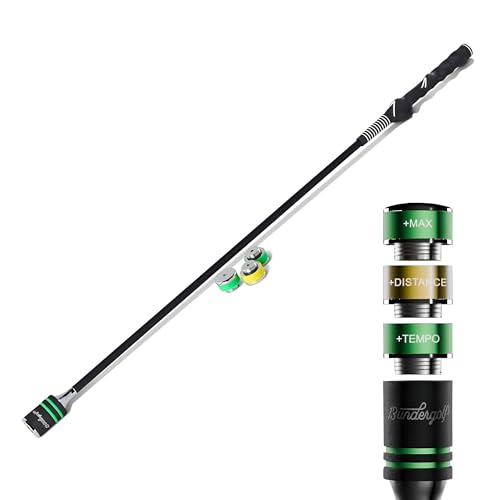
13 Under Golf TA25 Weighted Golf Swing Trainer with Grip Trainer
13 Under Golf TA25 Weighted Golf Swing Trainer with Grip Trainer, No Ribbon | 3 Stackable Weights for Swing Speed, Tempo & Lag, Built-In Grip Trainer, 40 Inch Warm-Up Stick That Fits in Your Bag
Best for: Overall use across speed, tempo and lag training.
This option suits families who want one trainer that covers several drills. Its three stackable weights and built-in grip trainer make it a practical all-round choice for a junior’s bag.
Pros
- Three stackable weights for different swing feels
- Built-in grip trainer and 40-inch shaft fit in a bag
Cons
- The shorter 40-inch length may feel small for taller juniors
Gowolf Golf Swing Trainer with Adjustable Weights
Gowolf Golf Swing Trainer with Adjustable Weights (35g & 50g) – 40in Carbon Fiber Golf Training Aid for Speed, Driving Distance & Tempo, Ideal Warm-Up & Strength Golf Accessories for Men & Women
Best for: Weight adjustment as strength grows.
Parents who want a trainer that progresses with their child will appreciate the 35g and 50g options. The carbon fiber shaft is listed at 40 inches.
Pros
- Two manufacturer-listed weight options
- Carbon fiber construction for a light feel
Cons
- Only two weight settings compared with some rivals
Orange Whip Golf Swing Trainer Aid
Orange Whip Golf Swing Trainer Aid, Patented Counterbalanced Golf Swing Aid, Made in the USA, 47"
Best for: A counterbalanced feel for tempo work.
This trainer suits juniors who respond well to a balanced, deliberate swing. Its 47-inch length is listed as made in the USA.
Pros
- Patented counterbalanced design
- Made in the USA according to the listing
Cons
- Owners often note it is a single-feel tool with no weight changes
HH-GOLF Golf Swing Speed Trainer
HH-GOLF Golf Swing Speed Trainer Golf Training Aid and Correction for Strength Golf Warm-up Stick Tempo Flexibility Training Club, with 3 Different Weights
Best for: Multiple weight options for speed training.
This option fits juniors working on swing speed and warm-up routines. Three weight choices let parents adjust the challenge.
Pros
- Three different weights included
- Covers strength, tempo and flexibility drills
Cons
- Listing detail on grip feel is limited
Amazon Basics Golf Swing Trainer Aid and Warm-Up Stick
Amazon Basics Golf Swing Trainer Aid and Warm-Up Stick for Grip, Balance, Distance, Power, Strength & Tempo Training, 48 Inches
Best for: A simple, low-commitment starter trainer.
Families new to weighted trainers may prefer a straightforward design. The 48-inch stick covers grip, balance and tempo work.
Pros
- Simple design that is easy to understand
- 48-inch length suits taller juniors
Cons
- Fewer features than specialized trainers
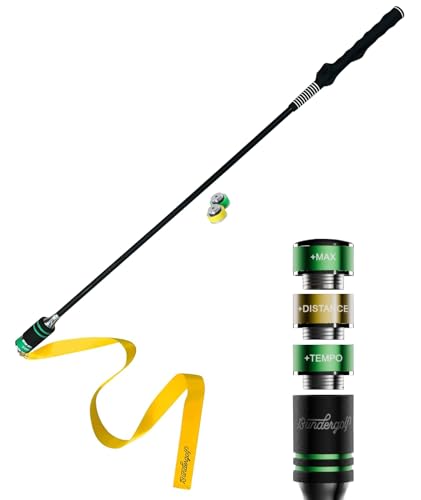
TA25R Golf Swing Trainer Aid with Ribbon
TA25R Golf Swing Trainer Aid with Ribbon (Right-Handed) for Indoor Practice Speed and Impact Training, Improved Rhythm, Grip, Flexibility, Balance, Tempo and Strength
Best for: Indoor drills that rely on ribbon feedback.
This right-handed model suits juniors practicing rhythm indoors, where a ribbon helps show swing path and tempo.
Pros
- Ribbon adds visual feedback for rhythm
- Designed for indoor practice
Cons
- Right-handed only, so left-handed juniors need another option
Buying Guide
Weight Options and Adjustability
Many weighted swing trainers offer more than one weight setting, which lets you match the training load to your current strength and speed goals. Starting with a lighter option is a sensible way to protect your shoulders and build good mechanics before moving to heavier loads. Adjustable or stackable weights give you room to progress over time without buying a new trainer.
Consider whether you want a single fixed weight for simplicity or multiple settings for a broader training range. Adjustable systems are especially useful for juniors who are still growing and gaining strength.
Length and Portability
Trainers in the 40 to 48 inch range are common, and length affects how the swing feels and how easy the aid is to store. Shorter sticks tend to fit more easily in a golf bag or car trunk, while longer ones can feel more like a full-length club for practicing a complete motion. Think about where you will practice most often before choosing a length.
Grip Design and Built-In Training Features
Some trainers include a grip trainer or a counterbalanced head to encourage proper hand placement and a smooth transition. If your main goal is improving grip pressure and hand position, look for a model with a dedicated grip section. Simpler sticks without these features can still be useful for general warm-up and tempo work.
Intended Use: Indoor, Outdoor or Both
Think about the space you have at home. Some models are better suited to open outdoor areas, while others work well in a garage or living room where you need to limit the swing arc. A ribbon or similar feature can also help you see swing path and tempo, which is helpful for indoor work where you may not have a range of motion to observe.
Build Quality and Materials
Materials such as carbon fiber or other durable composites generally offer a good balance of light weight and strength. Check how the weights are attached and whether the shaft feels solid through the swing. A well-built trainer will hold up to regular use and keep its balance over time.
FAQ
Can a weighted swing trainer help improve my junior’s swing speed?
Weighted trainers are commonly used to build the muscles and motion patterns associated with a faster swing, along with tempo and rhythm. Results depend on consistent practice, proper technique and age-appropriate loads. A coach or instructor can help make sure the training is safe and suited to your junior.
Is a weighted swing trainer safe for kids?
Many trainers are marketed to a wide range of ages, but it is wise to start with the lightest weight and short practice sessions. Watch for fatigue or discomfort, especially in the shoulders, elbows and wrists. Choosing a model with adjustable weights makes it easier to increase the load gradually.
How often should I use a weighted golf trainer?
Many golfers use these trainers as a warm-up before playing or practicing, with a few short sets of slow, controlled swings. Doing this several times a week tends to be more effective than occasional long sessions. Rest days are important so your muscles can recover.
Do I need a right-handed or left-handed model?
Some trainers are designed for a specific hand orientation, particularly those with a grip trainer or ribbon feature. Check the product name or description to confirm which version matches your junior’s dominant hand before ordering. Using the correct orientation helps the training carry over to the real swing.
Will these trainers replace regular practice with a club?
Weighted trainers are best used as a supplement to hitting balls and working with a coach. They help with strength, tempo and movement patterns, but they do not replace the feedback you get from striking a ball. Combining both approaches usually gives the most balanced development.
Conclusion
For juniors who need a versatile, adjustable option for building strength and tempo, a model with multiple weight settings and a sturdy shaft is a strong starting point. Families looking for a simple, portable warm-up tool may prefer a shorter, lighter trainer that fits easily in a golf bag. Matching the trainer to your practice space, your junior’s current strength and your training goals will help you choose the right fit.
Players focused on grip and hand position should look for a model with a built-in grip trainer, while those who practice mostly indoors may benefit from a ribbon or other feature that makes swing path easier to see. Whichever option you choose, start light, progress gradually and keep sessions short and controlled.
Related reading
- Golf Swing Trainer Machine: How to Choose and Use One for Junior Swings
- Golf Swing Trainer Circle: 3 Best Options for Home Practice (2026)
- 4 Best Golf Swing Trainer Weight Options for Better Tempo and Speed
- Top 6 Breaking 80 Golf Practice Nets for Junior and Home Swings
- PVC DIY Golf Practice Net: Build One for Backyard Swings (Step-by-Step)
- Make Your Own Golf Practice Net: A Step-by-Step Guide for Backyard Swings
About Claire Whitaker
Claire Whitaker is part of our editorial team and reviews and edits our junior golf gear guides, checking product details against manufacturer specifications and owner feedback.
About the author
Claire Whitaker writes reviews and buying guides for Junior Golf Results.